2026
“Memory and time, both immaterial, are rivers with no banks and constantly merging. Both escape our will, though we depend on them.”Â
From Night by Etel AdnanÂ
Landscapes preserve memories. Sedimentary layers in soils and waters trace social, historical, and ecological processes that continue to be shaped by the past. That which was remains inscribed and blends in myriad ways into the countless entanglements of human and non-human actors. In the region of Lusatia, which straddles Germany and Poland, traces of the past are visible in the brownish coloration of the Spree River and adjacent waterways. Since the mining of lignite, or “brown coal” came to a halt here, the groundwater level has begun to rise again, causing iron oxide stored in the excavated soil to enter the water and turn it reddish-brown. The water is filtered at several points to maintain its quality, yet the consequences of centuries of slow violence remain visibly inscribed in this landscape.Â
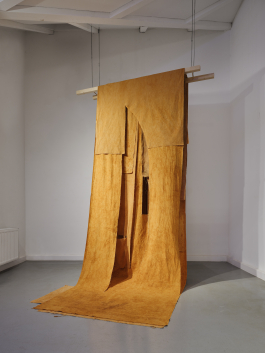
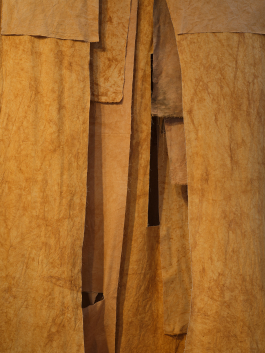
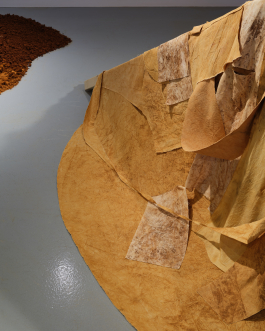
In her practice, Marei Loellmann explores the relationships between land, time and body. Over the space of a year, she recorded these traces of industrial intervention by dyeing fabrics directly in Lusatia’s ochre-coloured waters and in the basins of filtration plants. The fabrics were then soaked, rubbed, folded, and layered. Incisions in the material bring the layers into dialogue with one another. Loellmann’s practice is based on a method in which body, place, and event interact in time-based processes. Her on-site work and continuous physical contact with the materials demand presence, consistency, and perseverance within the physical conditions of the landscape – and its wounds are integral to her pieces.
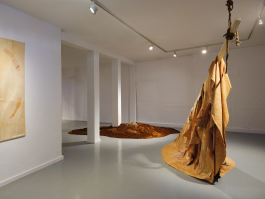
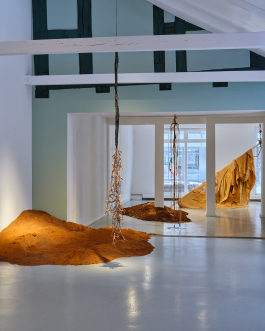
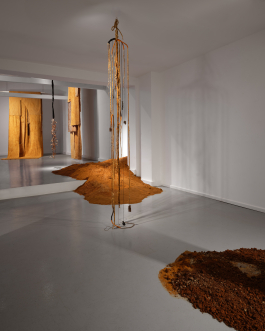
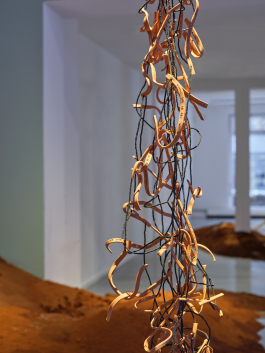
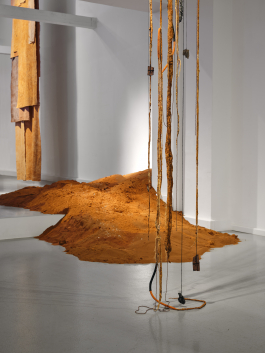
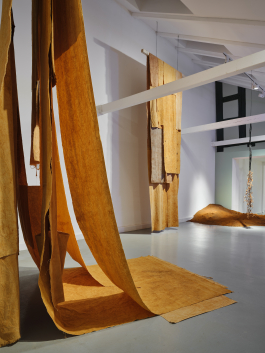
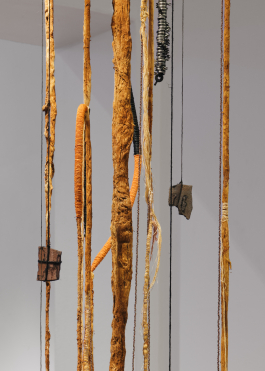
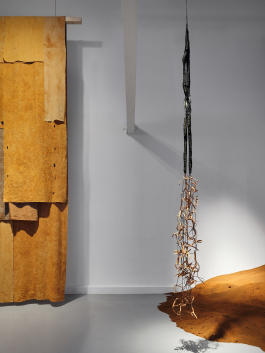
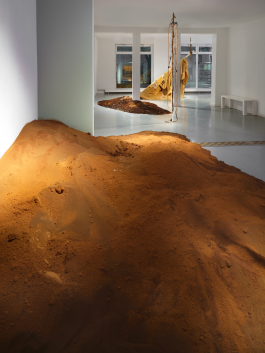
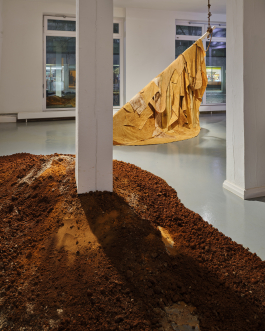
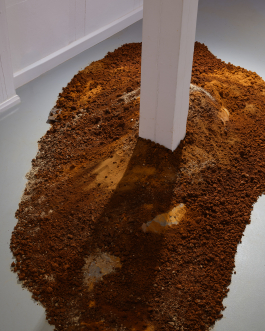
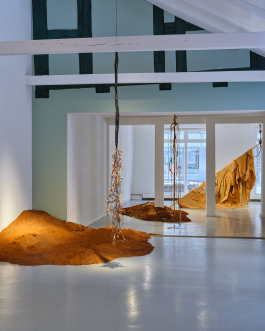
The exhibition is conceived as a spatial installation, integrating textiles, sculptural assemblages suspended from the ceiling, and a floor work made of iron oxide, mud and ash. The installation functions as a porous archive, registering and transmitting sensual traces of lived experiences and ecological transformations. Works extend into adjacent rooms, and transitions dissolve clear spatial boundaries. Sculptural assemblages of fired clay containing fragments of text, metal wire, ropes, threads, beads, and silk soaked in iron oxide mud reveal additional layers of meaning. These kinetic pieces respond to air currents and constantly rearrange themselves. Fragments of dreams and memories continually shift and reconfigure, allowing for numerous interpretations. Different temporalities coexist without forming a closed narrative.Â
Upheaval is omnipresent in landscapes, architecture, and biographies. Post-industrial landscapes like Lusatia not only preserve traces of the past but also open up far-reaching perspectives for remembering and reflecting on the present and future. These collected works specifically highlight slow, gradual processes, the effects of which often become visible only through their materiality. The exhibition invites us to question internalized notions of progress and time. The use of soil and water is a material, physical, and ecological process that integrates human and non-human bodies across social, generational, and geological boundaries. By observing this process, we come to see that time does not merely pass, but that we experience, bear, and cultivate it together.


photos: Michael Depasquale, Carolin Seeliger

sound calling down, 2025
381 Ă— 128 cm; river sediments, cotton fabrics, latex
sound calling down, 2025
sequence raveled out of sound, 2025
The textile works sound calling down and sequence raveled out of sound engage with contaminated landscapes as living archives and resistant bodies, exploring how time inscribes itself in matter - not as linear progress, but as sedimented memory: fragile, fragmented, and non-linear. The starting point is the brown discoloration of the Spree and adjacent waters in Lusatia - a consequence of rising groundwater following the closure of open-cast lignite mines. The released iron oxide mud is a relic of profound extractivist interventions in land and bodies. Over several months, the artist dyed textiles directly in the waters and filtration systems. The fabrics function as breathing archives - they store traces, change, and resist legibility. The landscape itself becomes a witness: memory here is not fixed but remains in motion - fragmented, embodied, and intimate.

Dyeing process in a water filtration facility, Schwarze Pumpe, 2025

sequence raveled out of sound (I), 2025
river sediments, silk, cotton; 127 x 152 cm

sequence raveled out of sound (II), 2025
123 x 161 cm; river sediments, cotton, silk, tull fabric


Photos: Michael Depasquale, Carolin Seeliger